








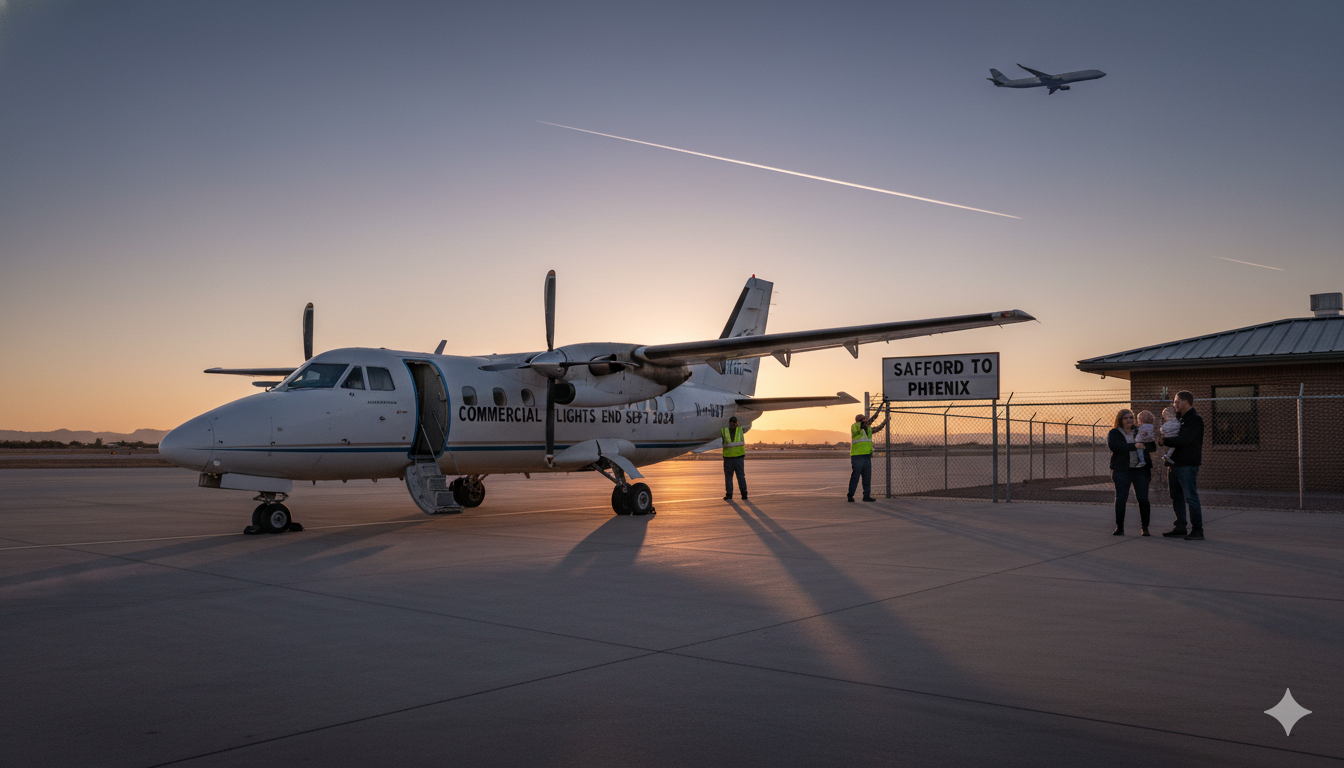
Have you ever had a local service that made life so much easier, only to see it disappear just as you were getting used to it? That is exactly how many people in Graham County feel right now. For a short time, folks in the Gila Valley could skip the long drive to the big city and hop on a quick plane ride instead. But sadly, Safford Airport Commercial Flights End as of September 2024. It was a convenient way to travel, but unfortunately, the planes have stopped rolling down the runway for scheduled trips to Phoenix.
This change has left many neighbors wondering why this happened and what it means for our community. Traveling is a big part of life, whether you are heading out for a business meeting or visiting family for the holidays. Having a local airport with commercial service was a huge boost for our area’s pride and economy. In this article, we are going to dive deep into the details of why these flights stopped and what the future might look like for our local skies.
Why Did Safford Airport Commercial Flights End?
The biggest reason safford airport commercial flights end boils down to money. Running an airline is very expensive. To keep ticket prices low enough for people to buy them, the government often helps pay for the flights. This is called a subsidy. Safford received a large grant of $800,000 to help start the service to Phoenix Sky Harbor. However, that money didn’t last as long as everyone hoped.
Fuel costs, maintenance, and paying pilots add up quickly. Even though many people loved the service, there weren’t quite enough passengers to cover all those costs without extra help. When the City Council decided they couldn’t provide more money at this time, the airline had to make the tough choice to stop. It wasn’t because people didn’t want to fly; it was just a matter of the math not working out for the long haul.
A Look Back: The Route to Phoenix
The service that recently ended was operated by Grand Canyon Scenic Airlines. It started with a lot of excitement in January 2025. For the first time in decades, you could walk into our local airport and fly straight to one of the busiest hubs in the country. At first, there were two flights every day. This gave people plenty of options for their travel schedules.
As the months went on, the schedule was cut back to just one flight a day to try and save money. The planes used were smaller aircraft, like the Cessna Caravans, which are perfect for short hops over the mountains. Even though the flights were often on time and the service was friendly, the “Minimum Revenue Guarantee” needed to keep the airline profitable was just too high to sustain without more state or federal funding.
Impact on the Gila Valley Community
When safford airport commercial flights end, it affects more than just the people who were on the planes. It impacts our local businesses too. Large companies, like Freeport-McMoRan, often need to move employees and experts in and out of the region quickly. Without a commercial flight, everyone has to spend three hours or more driving to Phoenix or Tucson.
For residents, it means more time spent on the road and more money spent on gas. It also makes it a bit harder for tourists or specialists to visit Safford. Small towns thrive on being connected to the rest of the world. Losing that direct link to a major airport like Sky Harbor feels like a step backward for some, though the airport itself remains very busy with private pilots and emergency medical flights.
The History of Safford Regional Airport
Safford Regional Airport (SAD) has a long and interesting history. It wasn’t always just a place for small private planes. Back before the airline industry was deregulated in the late 1970s, it was much easier for small towns to have regular flight services. After the rules changed, airlines started focusing only on big cities where they could make the most profit.
Safford Airport Quick Facts & Biography
| Feature | Details |
| Airport Name | Safford Regional Airport |
| FAA Code | KSAD / SAD |
| Location | Safford, Graham County, Arizona |
| Primary Runway | 6,006 feet (Asphalt) |
| Recent Airline | Grand Canyon Scenic Airlines |
| Recent Destination | Phoenix Sky Harbor (PHX) |
| Reason for Service End | Funding and Subsidy Depletion |
| FBO Provider | Spalsbury Aviation |
What Happens to the Airport Now?
Just because safford airport commercial flights end doesn’t mean the airport is closing! In fact, Safford Regional is still a very active place. It serves as a vital hub for “General Aviation.” This includes private pilots who fly for fun or business, as well as flight schools where new pilots learn the ropes.
The airport is also a critical base for PHI Air Medical. These are the helicopters and planes that fly people to bigger hospitals during emergencies. Without this airport, many life-saving services wouldn’t be able to reach our community as quickly. So, while you can’t buy a ticket for a scheduled flight right now, the hangars are still full and the engines are still humming.
Will Commercial Flights Ever Return?
Many people are hopeful that we will see planes taking passengers to Phoenix again. Airport Manager Cameron Atkins and other local leaders are working hard to find new ways to pay for the service. They are talking to the state legislature to see if Arizona can create a special fund just for rural airports. Other states, like New Mexico, already do this to help their small towns stay connected.
If a new grant or a different airline comes along, the service could start back up. It might require a different type of plane or a different schedule, but the dream isn’t dead. The infrastructure is already there, and the community has shown that there is a real demand for air travel. It’s all about finding a sustainable way to keep the wings moving without breaking the bank.
How to Travel from Safford to Phoenix Now
Since safford airport commercial flights end, you will need to plan your trips a bit differently. Most people will go back to the traditional way of getting to the city: driving. The trip usually takes about 2.5 to 3 hours depending on traffic and where in the Valley you are heading.
- Personal Vehicle: The most common choice. Ensure your car is ready for the desert heat!
- Shuttle Services: There are a few private shuttle companies that operate in the area.
- Rental Cars: Companies like Enterprise are still located near the airport to help travelers.
- Tucson Alternative: Sometimes it is easier to drive to Tucson International Airport (TUS) instead of Phoenix, depending on your final destination.
The Role of Government Grants in Rural Flying
You might wonder why the government gets involved in flying at all. Programs like the Small Community Air Service Development Program (SCASDP) exist because the government knows that rural areas need help. If every flight had to pay for itself purely through ticket sales, a seat from Safford to Phoenix might cost $500 or more!
Most people wouldn’t pay that much. So, the government provides money to keep the ticket prices around $50 to $100. This makes it affordable for regular families and small business owners. When safford airport commercial flights end, it’s often because these specific grants ran out or the “Minimum Revenue Guarantee” (MRG) was higher than the available budget.
Comparing Safford to Other Arizona Airports
Safford isn’t alone in this struggle. Many small cities in Arizona, like Prescott, Page, and Kingman, deal with the same issues. Some are successful because they have a lot of tourists (like Page with the Grand Canyon), while others struggle because they are just close enough to a big city that people decide to drive instead.
The “drive-to” factor is a big deal. Because Safford is only a few hours from Phoenix, some travelers feel it’s easier to just jump in their own car than to deal with airport security and flight schedules. This makes it harder for airlines to get the high “load factors” (the percentage of seats filled) they need to stay in business without help.
Expert Tips for Using Small Regional Airports
If commercial flights do return, or if you use other small airports nearby, here are a few tips to make your trip better. Small airports are different than big ones like Sky Harbor!
- Arrive Early, but Not Too Early: You don’t need two hours for security, but 45 minutes is usually smart.
- Check Luggage Limits: Small planes have very strict weight limits. Your giant suitcase might not fit!
- Support Local: The more people use the service, the more likely it is to stay.
- Flexible Pricing: Usually, tickets are cheaper if you book them far in advance.
Frequently Asked Questions
1. When exactly did the flights stop?
Commercial service between Safford and Phoenix officially ended in mid-September 2024.
2. Can I still fly my own plane to Safford?
Yes! The airport remains open 24/7 for private pilots, corporate jets, and emergency services.
3. Is there a shuttle from Safford to Phoenix Airport?
While there is no “official” airport shuttle, several private transport companies in the Gila Valley offer rides to Sky Harbor.
4. Why was the flight to Phoenix so short-lived?
The service lasted about nine months. It ended because the grant money used to lower ticket prices was spent faster than expected.
5. Which airline was flying out of Safford?
The most recent carrier was Grand Canyon Scenic Airlines, using small Cessna aircraft.
6. Will Boutique Air or Great Lakes ever come back?
While there are no current plans, the city is always open to talking with different airlines about returning to the Gila Valley.
Conclusion: Looking Toward the Horizon
While it is disappointing that safford airport commercial flights end, the story of Safford Regional Airport is far from over. Our airport continues to be a vital piece of the Gila Valley, supporting medical heroes, business leaders, and private pilots every single day. The nine months of commercial service proved that our community is ready and willing to fly—we just need a long-term plan to make it affordable for everyone.
If you want to see flights return, stay involved with your local City Council and voice your support for regional travel. Connectivity is what helps our small towns grow and stay vibrant. For now, we might have to spend a little more time on the highway, but we will always keep our eyes on the sky!