









Introduction
The disruption caused by the arkleston road renfrew emergency fault wasn’t just another inconvenient road closure—it was a clear sign that critical infrastructure is being stretched far beyond what it can handle. Anyone treating it as a one-off incident is missing the bigger problem. This wasn’t bad luck. It was predictable.
What actually broke beneath Arkleston Road
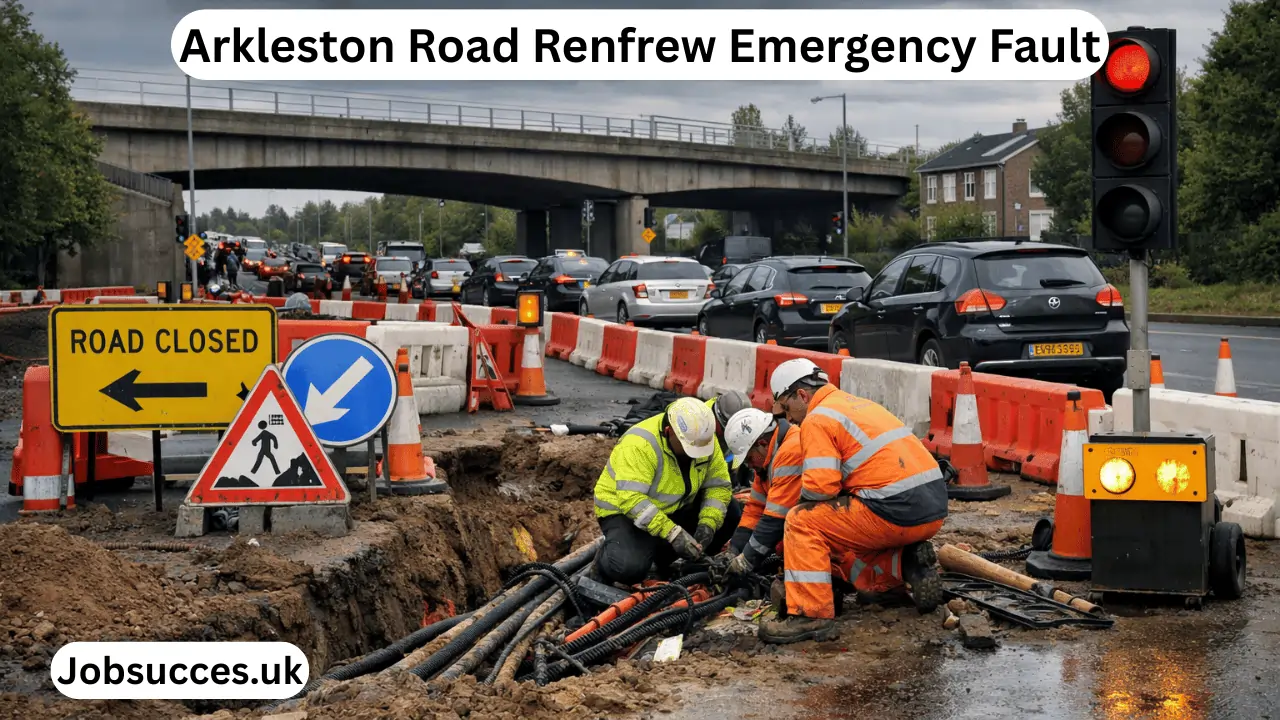
At the center of the arkleston road renfrew emergency fault was a failure in underground high-voltage electrical cables. Not a minor issue, not a surface-level repair job—this was deep infrastructure failure that required cutting into a major route and replacing large sections of critical power supply lines.
Reports indicate that around 300 meters of cable had to be replaced. That’s not routine maintenance. That’s a sign the system had already deteriorated to a point where patchwork fixes were no longer enough.
And once those cables failed, the situation escalated quickly. Road closures followed. Traffic backed up toward the M8. Emergency teams had no choice but to shut down access and dig in.
This is where the arkleston road renfrew emergency fault becomes more than a local issue—it becomes a case study in what happens when aging infrastructure is left to run until failure.
Why this wasn’t just “unexpected”
There’s a tendency to describe incidents like the arkleston road renfrew emergency fault as sudden. That word gets used a lot. It shouldn’t.
High-voltage cables don’t just fail out of nowhere. They degrade over time due to load pressure, environmental conditions, and physical stress. Add in water exposure, ground movement, or nearby construction vibration, and failure becomes a matter of when—not if.
In this case, there were additional stress factors:
- Proximity to a busy motorway link
- Structural strain near a bridge crossing
- External damage risks, including vehicle strikes
When a lorry struck the bridge near Arkleston Road, it didn’t just create surface damage. It likely contributed to underlying stress that pushed already fragile systems over the edge.
So calling the arkleston road renfrew emergency fault “unexpected” avoids accountability. The warning signs were there.
The timeline shows a pattern, not an isolated event
The arkleston road renfrew emergency fault gained attention in mid-2025 when a major closure lasted around ten days. But that wasn’t the beginning—and it likely won’t be the end.
What stands out is how long the recovery process has dragged on. Even after the road reopened, traffic restrictions didn’t disappear. Temporary lights remained. Lane access stayed limited. Drivers kept dealing with delays well beyond the initial repair window.
There are also indications that full restoration could stretch into 2026 or even 2027.
That’s not how short-term emergencies behave. That’s how long-term infrastructure problems unfold.
The arkleston road renfrew emergency fault fits into a broader pattern: systems fail, emergency repairs patch the worst damage, and then the area operates in a semi-recovered state for years.
Traffic disruption wasn’t the worst part
Most coverage focused on congestion. And yes, the arkleston road renfrew emergency fault caused serious traffic problems. Diversions pushed drivers onto already busy routes. Peak-hour travel became unpredictable.
But traffic delays weren’t the most damaging consequence.
Local businesses took a hit that doesn’t show up in traffic reports. Reduced footfall, delayed deliveries, and customer avoidance turned a road issue into an economic one. When access becomes difficult, people simply go elsewhere.
Residents faced a different set of problems. Potential power disruptions, reduced service reliability, and constant construction noise turned daily life into a waiting game.
The arkleston road renfrew emergency fault wasn’t just a transport issue—it disrupted how the area functioned.
Emergency response worked—but it exposed limitations
Scottish Power and local authorities moved quickly once the fault was identified. That part deserves credit. The site was secured, diagnostics were run, and repair teams got to work.
But speed alone doesn’t equal effectiveness.
The scale of the repair—hundreds of meters of cable replacement—meant the response was always going to be reactive rather than preventive. By the time crews arrived, the damage had already forced major disruption.
That’s the uncomfortable reality behind the arkleston road renfrew emergency fault. Emergency response systems are built to react, not to prevent. And when prevention fails, even a fast response still leads to days or weeks of disruption.
The hidden issue: infrastructure that’s quietly aging out
The most important takeaway from the arkleston road renfrew emergency fault isn’t the road closure itself. It’s what it reveals about infrastructure that most people never see.
Underground cable networks across the UK are aging. Some have been in place for decades. They were designed for different usage levels, different environmental conditions, and a different era of demand.
Now they’re carrying heavier loads, facing more stress, and receiving inconsistent upgrades.
The Arkleston Road incident is not unique. It’s just visible.
And visibility changes how people react. When a failure disrupts a major route, it becomes news. But similar failures happen in less visible ways all the time—minor outages, localized faults, temporary fixes.
The arkleston road renfrew emergency fault forced a larger conversation because it couldn’t be ignored.
Could this have been prevented?
That’s the question people keep asking—and it’s the wrong one if you expect a simple answer.
Could better maintenance have delayed the arkleston road renfrew emergency fault? Probably.
Could earlier replacement of aging cables have prevented it entirely? Possibly.
Was it realistically going to happen at some point anyway? Very likely.
Infrastructure doesn’t fail because of one mistake. It fails because small risks accumulate over time without being fully addressed.
What matters more is whether lessons are taken seriously.
If the same conditions exist elsewhere—and they do—then similar incidents will follow.
Why this incident matters beyond Renfrew
It’s easy to treat the arkleston road renfrew emergency fault as a local story. It isn’t.
This is what infrastructure stress looks like in real time:
- A single failure triggers multi-day disruption
- Repairs take longer than expected
- Full recovery stretches into years
- Economic impact spreads quietly
Now scale that across other towns and cities.
The bigger concern isn’t one road in Renfrew. It’s how many other roads are sitting above similar risks.
And unlike visible infrastructure like bridges or rail lines, underground systems don’t attract attention until they fail.
The long-term outlook isn’t reassuring
Even after repairs, the area isn’t back to normal. That’s the part that often gets overlooked.
The arkleston road renfrew emergency fault didn’t end when the road reopened. It transitioned into a prolonged period of reduced capacity and ongoing work.
Temporary fixes have a way of becoming semi-permanent. Traffic systems adjust. Drivers adapt. But the underlying issue doesn’t fully disappear.
If anything, it sets a precedent for how similar incidents will be handled: stabilize, reopen, manage ongoing disruption.
That’s not a fix. That’s containment.
What should actually change after this
If the arkleston road renfrew emergency fault leads to anything meaningful, it should be a shift in priorities.
Waiting for failure is the most expensive and disruptive way to manage infrastructure. Yet it keeps happening because proactive upgrades are harder to justify until something breaks.
That logic doesn’t hold up anymore.
The cost of prevention is visible on budgets.
The cost of failure shows up in daily life.
And when a single cable failure can disrupt an entire route for weeks, the argument for waiting becomes weak.
Conclusion
The arkleston road renfrew emergency fault didn’t just shut down a road—it exposed a system that’s being pushed to its limits while still expected to function without interruption. That expectation is unrealistic, and pretending otherwise only guarantees more incidents like this.
If nothing changes, this won’t be remembered as a warning. It’ll be remembered as the first of many.
FAQs
1. How long did the Arkleston Road disruption actually last?
The main closure lasted around ten days, but restrictions and traffic control measures continued long after reopening, with some impacts expected to stretch into future years.
2. Was the fault limited to electricity, or did it affect other services?
While the core issue involved high-voltage cables, incidents like this can indirectly affect water systems, local utilities, and service reliability in the surrounding area.
3. Why did repairs take so long compared to typical roadworks?
This wasn’t surface-level work. Crews had to locate the fault, excavate safely, replace large sections of underground cable, and test the system before restoring power and access.
4. Are similar faults likely to happen in other areas?
Yes. Aging underground infrastructure exists across many regions, and without proactive upgrades, similar failures are likely elsewhere.
5. Is Arkleston Road fully back to normal now?
Not entirely. Even after reopening, traffic management measures and ongoing work mean the area is still operating below normal capacity.
You May Also Read: Uyç: Redefining Digital Expression, Identity, and Modern Communication